Shot number
|
Shot type
|
Actor
|
Description
|
1
|
CU
|
N/A
|
Book opens showing title; ‘Broadmoor films’
|
2
|
N/A
|
Black screen with producers name
| |
3
|
CU
|
Main characters hand
|
Hand turns over the page. Directors name on screen
|
4
|
MS (panning)
|
N/A
|
Close up shot of blunt object/weapon whilst panning
|
5
|
N/A
|
Black screen with main actors name
| |
6
|
CU/XCU
|
Main characters hand
|
A hand rolling a pen between finger tips
|
7
|
N/A
|
Black screen with second actors name
| |
8
|
CU
|
Main characters hand
|
Shows a hand cutting up some newspaper headlines
|
9
|
N/A
|
Black screen with name of the film
| |
10
|
CU
|
Main characters arm
|
Shows an arm grabbing a closed book
|
11
|
CU/XCU
|
Main characters arm
|
Shows an arm turning pages in a book
|
12
|
CU
|
N/A
|
Pages turning showing another actor title
|
13
|
CU
|
Main characters hand
|
Writing notes in a book. Shows another actor title
|
14
|
CU
|
Main characters hand
|
The writing/notes made in books over laps the writing action
|
15
|
N/A
|
Black screen showing another actor title
| |
16
|
CU
|
Main characters hand
Victim 1
|
Shows hand cutting round edges of photos that have live victims on (victim 1)
|
17
|
N/A
|
Black screen showing another actor title
| |
18
|
CU/XCU
|
Main characters hand
Victim 2
|
Shows hand cutting up photos of victims when they are murdered (victim 2)
|
19
|
CU
|
Main characters hand
Victims 1 and 2
|
Shows the hand sliding pictures onto and across the page (victim 1 and 2)
|
20
|
CU
|
Main characters hand
|
Blood smothered over the page with handing running across it
|
21
|
CU
|
Main characters hand
|
Pages being turned over
|
22
|
CU
|
Main characters hand
|
Man writing notes onto the pages
|
23
|
CU
|
Main characters hand
|
Pages being turned over
|
24
|
CU
|
Main characters hand
|
Notes being written on the page and the hand over lapping
|
25
|
CU
|
Main characters hand
Victim 1
|
Black screen with spotlight on photo of live victim (victim 1) which shows hand drawing through eyes of the victims picture
|
26
|
CU
|
Main characters hand
Victim 1
|
Camera dead cuts to the whole face being crossed out (victim 1)
|
27
|
XCU
|
N/A
|
Extreme close up of the tip of the pen whilst in action
|
28
|
CU
|
Main characters hand
|
Shows photos being aligned on page, screen has red filter, title states ‘music by…’
|
29
|
CU
|
Main characters hands
|
Photo being stuck down to the page from height
|
30
|
N/A
|
Black screen with title saying ‘edited by…’
| |
31
|
CU
|
Main characters hand
|
Photo that has been stuck down to page being rubbed over by palm of hand
|
32
|
CU
|
Main characters hand
|
Typed up notes being picked up
|
33
|
CU
|
Main characters hand
|
Pages with pictures on them being turned over
|
34
|
N/A
|
Black screen with title stating the director of photography
| |
35
|
CU
|
Main characters hand
|
Pen being held up in the air
|
36
|
N/A
|
Black screen with title showing the executive producers
| |
37
|
MS (panning)
|
N/A
|
Panning shot of filing cabinet with title saying ‘written by…’
|
38
|
CU
|
Main characters hand
|
Shuffling the papers together and then banging them on the table to line them up then laying them down
|
39
|
N/A
|
Black screen with title saying ‘produced by…’
| |
40
|
MS (panning)
|
N/A
|
Panning of filing cabinet
|
41
|
N/A
|
Black screen with title saying ‘directed by…’
|
Planning: Shot List

Planning: Location
In all genres, location is very important but for the genre of horror it is particularly important and you could argue it is the one film genre that is it vital for the location to be spot on. For this reason it is important that we find a location suitable for us to film from to create a strong opening to our horror film.

For the location planning, our group needed to decide what the most suitable location was to film our opening. After reviewing several different locations we decided that the kitchen worktop in the picture below was the most suitable location. This is the case as we needed a location that for starters was indoors. We needed it indoors because of the lighting, camera shots and angles etc. This location obviously ticks the box. Also, we needed somewhere that had a desk/unit allowing us to put all the props we are going to use on top of. This again adds to the suitability of the location as this location allowed us to do this. In addition, we needed a location that was dark and secluded to add a sense of mystery and suspension in our opening. Although the picture below looks quick bright this can be easily adjusted as the blinds in the room affect the light levels coming into the room to the extent you want. Furthermore, there is plenty of space around the desk (where the picture is being taken from) which was again something that was important to the filming of our opening. This was important as this space allowed us to affect many different factors such as camera shots and angles and therefore meant we had more potential to create a good opening.
Overall, when you consider the requirements of the location we wanted and what we actually have to work with, you have to conclude that this location has the potential the create a good opening. This is the case as explained above, it is extremely suitable as it has everything we want such as a unit to put the props on, the ability to make it dark and secluded to create mystery etc.
Planning: Mise-en-scene
The term 'mise en scene' is a french term that translates roughly into 'put into the scene'. Some examples of mise en scene include costumes, make up, props etc. Here below are some examples of the mise en scene that was included in our film opening;
 |
| This is a Stanley knife. This will be used several times in the opening to perform tasks such as cutting through the pages and slicing up pictures of victims. The use of this suggests that the killer is very precise and particular in what he does. The fact it's a knife also obviously indicates danger and brutality. |
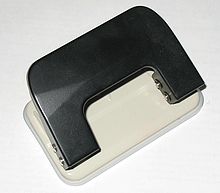 |
| This is a hole punch. This will be used to hole punch the paper that the killer had made notes on. The aggressive way in which they use this tells us they have a vicious side to their character. Also, the use of this object shows that the killer is very organised and he orders the papers, straightens them and uses the hole punch. This shows organisation and that they are a meticulous planner. |
 |
| This is a pen. This is used on several different occasions during the opening where the psychiatric makes notes with the pen, twiddles the pen in between his thumbs etc. this suggests the killer pays a lot of attention to detail and the camera will be focused on the hands with the pen in it to create a sense of mystery and enigma. |
| This is a stapler. This isn't used in the opening but is present on the desk of the killer. The presence of this object again shows the organisation of the character as it allowed the papers to be organised and therefore the character could refer back to important information easily. |
Planning: Storyboard
Creating a storyboard is useful and is an important stage of planning. It is both useful and important because it gives you a good idea of what the film opening is going to be allowing you to assess the strengths and weaknesses and therefore make improvements should they be required. It gives you a good understanding of what is going to be achieved and it gives you something to build upon. Here below is the storyboard for our film opening;


You can see that our storyboard has good detail which was very useful to our group as it gives us a very accurate idea of what our film opening is going to be like. Also, it makes it much easier for the planning of other things such as the casting, location and mise en scene. This is the case as all the information required to carry out these planning stages is included in the storyboard. Furthermore, it also gave a rough idea of the camera angles/shots/movements etc. that will be used when we come to film and therefore it becomes a very useful tool to refer back to when we come to do the filming for the opening.
Subscribe to:
Posts (Atom)